
Understanding Your Profit Margin: How to Calculate and Improve It

Understanding Your Profit Margin: How to Calculate and Improve It
August 18, 2026 | Grace Tan | Business Advice
When you run your own business, there’s a lot to keep your eyes on. You may need to monitor your stock levels, your number of incoming leads, your unpaid invoices, your emails, your appointments, and much, much more. So, with all that to constantly keep on top of, are you also making time to review your profit margin? If not, then how do you know how well your business is doing? Understanding your profit margin can seem like one of those business textbook tasks, but it’s essential for all business owners to ensure your business can stay afloat and make you money.
What is profit margin?

A business’s profit margin shows how much of its revenue is left as profit after the relevant costs of running the business have been deducted. It is expressed as a percentage and is commonly used as a measure of profitability and financial health. The bigger the difference between expenditure and sales, the more money there is left over as profit and therefore the more ‘profitable’ the business. The smaller the difference signifies the opposite, and where there is less money left over in the business, it may show warning signs that the business is closer to only breaking even or even operating at a loss.
What is the difference between profit and profit margin?
The difference between profit and profit margin is that profit is the amount left after total costs have been deducted from total revenue. Profit margin shows this profit as a percentage of revenue, calculated by dividing profit by revenue and multiplying by 100.
Why is understanding your profit margin important?
Understanding your profit margin is important on many levels. It is not simply a figure included in your annual accounts; it is a useful measure of your business’s profitability and can help you make informed decisions about its future.
Your profit margin will usually be calculated from figures in your profit and loss account. While companies must prepare annual accounts, eligible small and micro-entities may be able to choose what information they file publicly with Companies House, including whether their profit and loss account is filed.
Primarily, understanding your profit margin can help you stay in control of your business and act accordingly to both opportunities and threats.
For example, your profit margin will show you whether you can afford to invest in your business should you want to expand and become even more profitable, or whether it is necessary to make spending cuts to achieve a healthier margin so that the business can continue to survive or weather any temporary struggles.
Understanding your profit margin as well as knowing how to improve it is also important should you need to apply for credit or loans. Creditors will want to see your financial reports, including your profit margin calculations, to determine how reliably and feasibly your business will be able to pay back outstanding debt. Furthermore, if you are looking for investors, then they are likely to want to see high profit margins as this will give them confidence that the business will be able to allocate dividend payments to shareholders.
What are the different types of profit margins?
As a business owner, there are three main types of profit margin that you should understand: gross profit margin, operating profit margin and net profit margin. Each measures profitability at a different stage after certain costs have been deducted.
Gross profit margin
Your gross profit margin shows how much profit your business makes from its sales after deducting the direct costs involved in producing your products or delivering your services. It is calculated before operating expenses, interest and tax are deducted.
Operating profit margin
Operating profit margin is a financial ratio that shows how much profit a business makes from its sales after deducting the costs involved in running the business, including the cost of goods sold (COGS) and operating expenses such as rent, wages and utilities. It is calculated before interest and tax are deducted.
Net profit margin
Net profit margin is a financial ratio that shows how much of a business’s sales are retained as profit after all expenses have been deducted, including operating costs, interest and tax. It measures how effectively a business turns its total revenue into net profit.
How to calculate profit margin
Profit margin is calculated by dividing profit by revenue and multiplying the result by 100. However, the calculation you use will depend on whether you are calculating your gross, operating or net profit margin
To calculate your gross profit margin, first subtract your direct costs from your sales revenue to work out your gross profit. You can then use this figure to calculate your gross profit margin as a percentage.
Gross profit margin formula
Gross profit margin shows how much profit a business makes from its sales after deducting the direct costs involved in producing its goods or delivering its services. It is calculated before operating expenses, interest and tax are deducted.
To calculate your gross profit margin, first subtract your direct costs from your sales revenue to work out your gross profit. You can then use this figure to calculate your gross profit margin as a percentage.
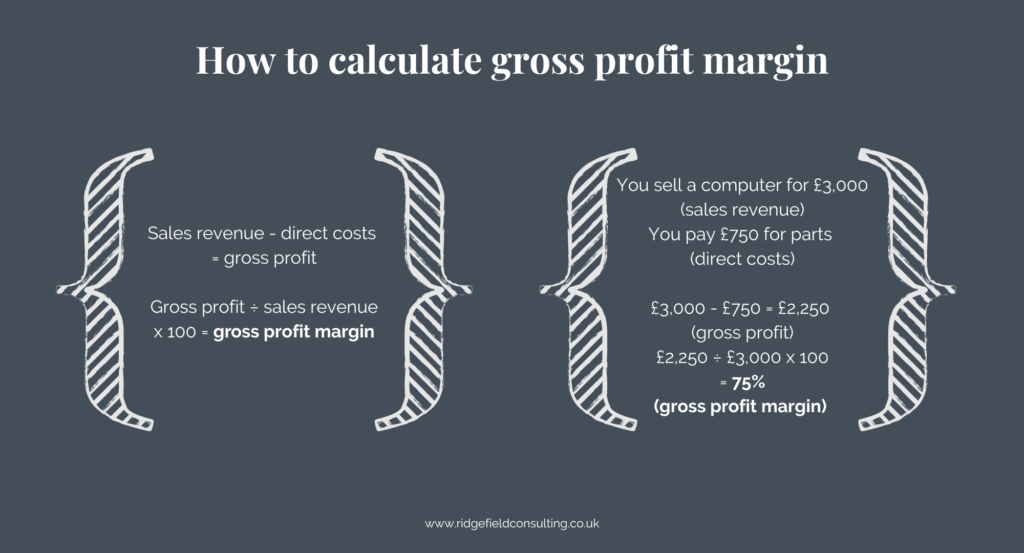
The formula is:
Sales revenue – direct costs = gross profit
(Gross profit ÷ sales revenue) × 100 = gross profit margin
For example, your business sells custom-made computers and you sell a computer for £3,000. You paid £750 for the parts needed to build the computer.
First, calculate your gross profit:
£3,000 – £750 = £2,250 gross profit
You can then calculate your gross profit margin:
(£2,250 ÷ £3,000) × 100 = 75%
Your gross profit margin is therefore 75%.
If you provide a service instead of selling goods, you can still use the same formula. For example, a client has commissioned you to create an online magazine, for which you charge them £1,500. If the cost of your labour is £45 per hour and the project takes you 18 hours to complete, you would calculate your profit margin as follows:
Direct costs: £45 × 18 hours = £810
Gross profit: £1,500 − £810 = £690
Gross profit margin: £690 ÷ £1,500 × 100 = 46%
Operating profit margin formula
To calculate your operating profit margin, you must first find out your operating income. This is calculated by taking your total revenue, then deducting your direct costs (as above) but also deducting your operating costs. Once you have this figure, you can divide it by your net sales revenue (your sales revenue minus any discounts or returns).
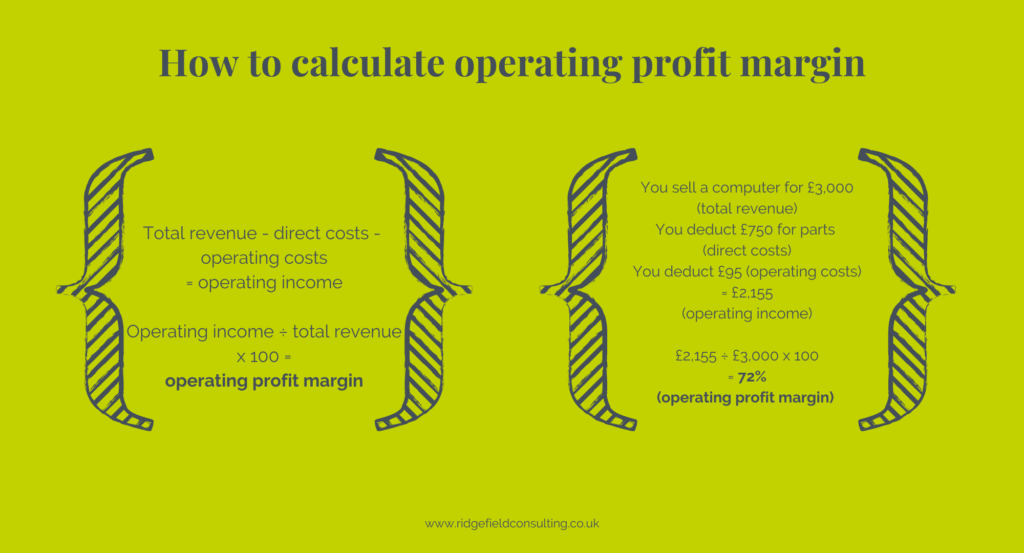
The operating profit margin formula is:
Total revenue – direct costs – operating costs = operating income
Operating income/sales x 100 = operating profit margin
Using the same example of a business selling custom-made computers, the direct costs are still £750 for parts. However, you now need to also deduct operating costs. We will use international courier shipping to deliver the computer to the customer as the cost which is £95. The total revenue is still £3,000 so you now minus £750 and £95, which is £2155. This figure is then divided by £3,000 (still the net sales revenue) and multiplied by 100, which leaves an operating profit margin of 71.8%.
£3,000 − £750 − £95 = £2,155 operating profit
£2,155 ÷ £3,000 × 100 = 71.8%
Understanding your operating profit margin is beneficial when you want to see how efficiently your business is running. The higher the operating profit margin, the better because it means that the cost of running your business is low compared to the amount of revenue you can make. On the other hand, a low operating profit margin may mean too many costly areas to running your business, but further investigation may allow you to see where you can cut costs.
Net profit margin formula
To calculate your net profit margin, you will need to deduct the direct costs, operating costs, any interest on debts the company has, and taxes owed by the company from the total revenue earned over a set period. This gives you the net profit. The net profit is then divided by total revenue and multiplied by 100 to calculate the net profit margin.
The net profit margin formula is:
Total revenue – direct costs – operating costs – interest – taxes = net profit
Net profit ÷ total revenue × 100 = net profit margin
For example, to find the net profit margin for the computer business above, you would take the total revenue of £3,000 for the computer sold and deduct £750 of direct costs, £95 in operating costs and £409 in taxes (assuming the company is subject to Corporation Tax at 19%.). This leaves a net profit of £1,746. We have left out interest for simplicity.
You can then calculate the net profit margin as follows:
£1,746 ÷ £3,000 × 100 = 58.2%
This gives the business a net profit margin of 58.2%, meaning it makes around 58p in net profit for every £1 of revenue after the costs included in the calculation have been deducted.
Understanding your net profit margin arguably gives you the fullest picture of your business’s profitability, as it takes into consideration the revenue generated and the expenses incurred. The higher the net profit margin, the more profit the business may have available to reinvest in the business or, where appropriate, distribute to shareholders as dividends.
What is a good profit margin?
There is no single profit margin that can be considered “good” for every business. What is a healthy or normal profit margin will vary depending on your industry, business model and stage of growth.
Different industries have different levels of costs and financial pressures. For example, a business selling physical products may have significant production, stock, shipping and logistics costs, while a service-based business may have fewer direct costs but higher staffing or professional costs.
When assessing whether your profit margin is healthy, it can be more useful to compare it with businesses that are similar to yours. Look for industry-specific averages and consider businesses that are a similar size and at a similar stage of development.
You should also consider how your profit margin changes over time. An established business may have a higher margin than a newer business investing heavily in growth, marketing, equipment, or staff.
A higher profit margin does not necessarily mean one business is performing better than another, particularly when comparing businesses in different industries. Instead, your profit margin shows how much of your revenue is retained as profit after the relevant costs have been deducted.
The most useful comparison is therefore your profit margin against businesses similar to yours and your own performance over time.
How to improve your profit margin
There are several ways a business can improve its profit margin, but the right approach will depend on your individual circumstances, industry and business model. Some options you could consider include:
- Choose products or services that allow you to optimise your pricing
If you sell products that are expensive to purchase at wholesale prices, you may have less flexibility when setting your selling price. Customers may also be less willing to pay a higher price for more expensive products. You should therefore consider whether the products you sell allow you to set a sustainable markup, while still remaining competitive.
A healthy markup can give you more flexibility to offer discounts, clear stock or run promotional periods such as seasonal sales without significantly reducing your profit.
If you provide services, consider which are the most time-consuming or labour-intensive and compare this with how much you can charge. You may find that some services can be delivered quickly and sold at a lower price, while others take longer but command a higher price because customers see greater value in them.
Optimising your pricing will also depend on demand for your products or services. You can gain insight by reviewing previous sales, monitoring customer behaviour and comparing your prices and offerings with competitors.
- Cross-sell or upsell to increase average sales value
Another way to improve your profit margin is to increase the amount customers spend with your business. Cross-selling involves offering related products or services, while upselling encourages a customer to choose a higher-priced option than the one they originally considered.
There are various strategies you can use, such as creating product bundles, offering relevant add-ons or allowing customers to personalise a product for an additional fee. For service providers, tiered service levels, such as bronze, silver and gold packages, can also encourage customers to choose a higher-value option.
However, it is important to consider the costs involved in providing any additional products or services to ensure that increasing sales also contributes to your overall profit margin.
- Incentivise brand loyalty to increase repeat purchases
Retaining existing customers can be more cost-effective than acquiring new ones, making customer retention an important consideration for many businesses. A steady stream of repeat customers can help reduce the amount you need to spend on marketing and advertising to generate sales.
Popular ways to encourage repeat purchases include loyalty schemes, referral schemes, personalised offers and subscriptions. Building strong relationships with customers can also encourage them to return and recommend your business to others.
- Reduce unnecessary operating costs
Carry out a thorough assessment of your business to identify unnecessary costs or bottlenecks that may be affecting the efficiency of your operations. Areas that could make a difference include production, shipping, maintenance and training.
If you outsource several areas of your business, consider whether each supplier and process is working efficiently together. You may also want to assess whether bringing certain activities in-house would give you greater control over costs and procedures.
If outsourcing remains the best option, review your suppliers regularly and compare the costs and service you receive with other available options.
- Increase productivity
Investing in effective systems, processes and technology can help your business increase productivity and reduce the time and resources required to complete tasks.
This could be as simple as creating a positive workplace culture where employees are motivated to work efficiently, collaborate and work towards shared goals. It could also involve introducing software that automates repetitive tasks and reduces the amount of time spent on manual processes.
Improving productivity may require you to test different solutions, establish new procedures and ensure that your team understands how to use them. However, finding more efficient ways of working can be a cost-effective way to reduce operating costs and improve your profit margin.
Get help with understanding and improving your profit margin
If you’re struggling to understand your profit margins, then you may benefit from our management accounts service. We cover much more than just your profit margins, but other key performance indicators relevant to your business, as well as provide analysis alongside financial reports so that you can make the best decisions to grow your business. If you’d like to find out more then please use the contact form to get in touch with us to book in a consultation to discuss your business.
Stay up to date
Subscribe to our monthly digest newsletter to stay on top of the latest tax changes, new rules, and practical tips.
Subscribe to our newsletter
Looking for some help?
If you’re ready to hire an accountant, then get started by completing our contact form for an introductory call to discuss your needs.
You can find out more about our Bookkeeping Service.
Related articles
We hope you enjoyed reading this article. If you would like to read
similar posts on this subject here are some more for you.
Back to Tax Guides Home